

Understanding Laravel’s request lifecycle can feel abstract. So let’s imagine your Laravel application is a restaurant. Here’s how everything works.
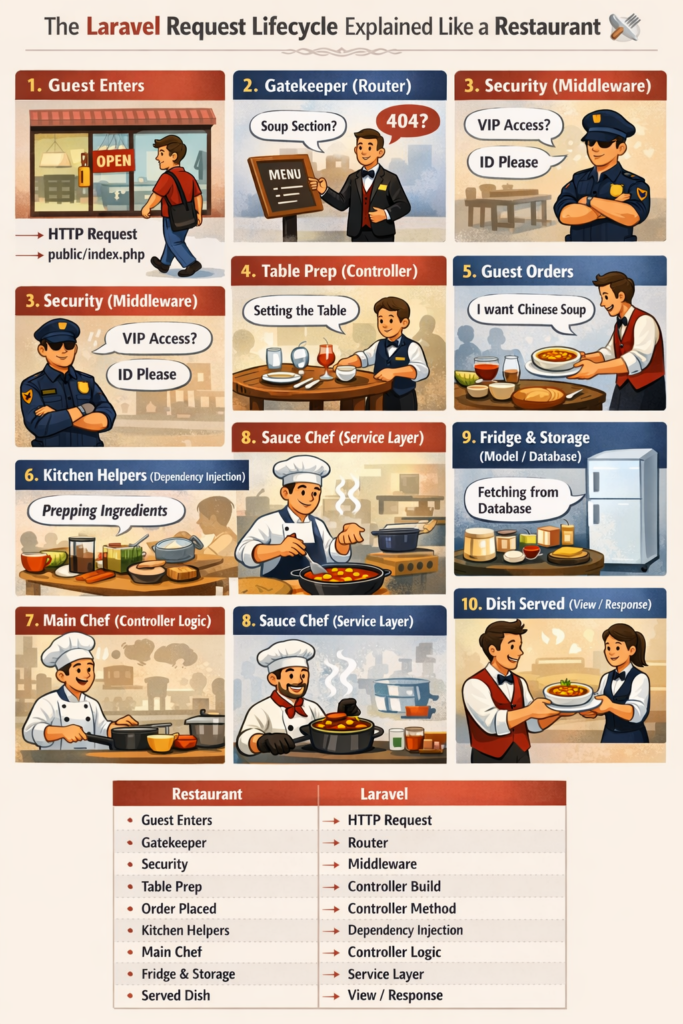
🏪 1. Guest Enters the Restaurant (HTTP Request)
A guest walks into the restaurant.
This is:
Browser → HTTP Request → public/index.php
Laravel boots up the application (like opening the restaurant for service).
The Service Container is prepared — like getting the restaurant infrastructure ready.
But no food is cooked yet.
🚪 2. Gatekeeper Directs the Guest (Router)
At the entrance, there’s a gatekeeper.
This is Laravel’s Router.
The gatekeeper checks:
- What does the guest want?
- Which section should they go to?
- Or should they be kicked out (404)?
Example:
Route::get('/soup', [FoodController::class, 'chineseSoup']);
If the guest asks for soup:
👉 The gatekeeper sends them to the Soup Section
If that section doesn’t exist:
❌ 404 — “Sorry, we don’t serve that.”
At this stage, the restaurant now knows:
- Which controller
- Which method
Only now can cooking begin.
🛂 3. Security Checks the Guest (Middleware)
Before the guest sits down, security checks:
- Is this guest logged in?
- Is this guest banned?
- Do they have VIP access?
This is Middleware.
Examples in Laravel:
auththrottleverified
If security rejects them:
🚫 Request ends here.
If approved:
👉 They are allowed to proceed.
🪑 4. Preparing the Table (Service Container Builds Controller)
Now the guest is guided to a table.
But before they sit:
- Table is cleaned
- Fresh tissues placed
- Water jug filled
- Plates arranged
This preparation is the Service Container creating the Controller instance.
Example controller:
class FoodController
{
    public function __construct(SoupService $service)
    {
        $this->service = $service;
    }
}
The container says:
“To prepare this table, I need SoupService.”
So it creates:
- SoupService
- And anything SoupService needs
Just like setting the table properly before the guest even orders.
🧾 5. Guest Places the Order (Controller Method)
The guest now says:
“I want Chinese soup.”
This is:
public function chineseSoup(Request $request)
Now we know exactly what dish is required.
👨🍳 6. Kitchen Prepares Ingredients (Dependency Injection)
Before the main chef cooks:
Kitchen helpers prepare:
- Water
- Pan
- Cut vegetables
- Masala
- Oil
These helpers are Dependency Injection.
They prepare everything the chef needs before he starts cooking.
Laravel does the same:
- It sees method parameters
- It resolves dependencies
- It injects them automatically
So the chef never goes looking for ingredients.
They’re already there.
🔥 7. Main Chef Cooks (Controller Logic)
Now the main chef starts cooking.
This is your controller method executing business logic.
But the chef doesn’t do everything alone.
🧑🍳 8. Sauce Chef (Service Layer)
To avoid overloading the main chef:
The Sauce Chef prepares sauces and special mixes.
This is your:
Service Layer
Instead of putting all logic inside the controller, you move heavy logic into services.
Good practice:
$this->service->prepareChineseSoup();
Now the controller stays clean.
🧊 9. Fridge & Storage (Model & Database)
If ingredients are needed:
- Vinegar
- Salt
- Stored vegetables
They are fetched from the fridge.
This is your:
Model → Database
Example:
Ingredient::find($id);
Models fetch raw data.
🍜 10. Dish is Served (View / Response)
Once the soup is ready:
It is plated nicely and served to the guest.
This is:
return view('soup', $data);
The View presents the final output.
The guest enjoys the meal.
Response sent back to browser.
🔁 Full Restaurant Flow (Mapped to Laravel)
| Restaurant | Laravel |
|---|---|
| Guest enters | HTTP Request |
| Gatekeeper | Router |
| Security | Middleware |
| Table preparation | Container builds controller |
| Order placed | Controller method |
| Kitchen helpers | Dependency Injection |
| Main chef | Controller logic |
| Sauce chef | Service layer |
| Fridge | Model / Database |
| Served dish | View / Response |
In Laravel:
- Request arrives
- Router decides destination
- Middleware checks
- Container builds controller
- Dependencies are injected
- Controller executes
- Services & models assist
- Response is returned